Unlock the secrets of digital music preservation by mastering the Proxomitron tool and proxy setup to permanently cache streaming audio from services like Pandora and Deezer, defying geographical restrictions and fleeting licenses.
In the vast, ever-shifting landscape of the digital ether, where melodies flow like ephemeral streams, a curious soul seeks permanence. The sirens of Pandora, Deezer, and their kin sing songs of boundless access, yet their gifts are often bound by invisible threads—geographical restrictions, fleeting licenses, the silent threat of a disappearing playlist. While dedicated tools exist, each a master of a single domain like Freezer for Deezer or VidToMP3 for YouTube, their power is limited. The quest, then, is for a more universal key, a method to coax the music from its transient home into a lasting form. This is not a path for the faint of heart, for it dances on the edge of Terms of Service and personal ethics—a tutorial provided as a curiosity, a tale of digital alchemy where the practitioner bears full responsibility for their arcane workings.
The journey begins not with a spell, but with a filter: the Proxomitron. A tool from a simpler digital age, yet its principles remain potent. Upon first invocation, its interface may seem a chaotic burst of visual noise, an eye-stabbing relic. Fear not. A click on Config, a selection of Don't use textures, and the chaos subsides. The crucial step lies in its filters. We must silence the whispers that tell data to vanish. Uncheck Web Page Filters, for they may obstruct the melodic flow. Then, venture into Edit Filters > Headers. Here, the magic is woven: enable Cache-Control: always cache (in) and Expires: always cache (in), while all other options are sent to the void. With a click of OK, the filter is attuned, ready to intercept and preserve.
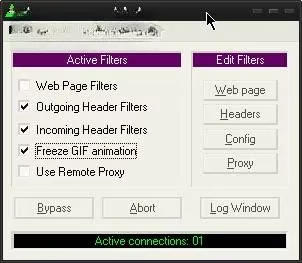
Now, the conduit must be established. The modern bard's tool of choice, the Firefox browser, must be taught to see through this filter. Its connection settings must be redirected, a proxy setup that routes every request through the waiting Proxomitron. This ensures that the streaming data, as it journeys from server to speaker, is compelled to linger in the local cache, defying its usual ephemeral nature.
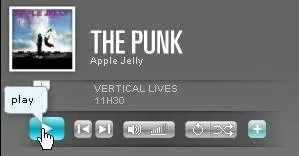
With the stage set, the performance can begin. Navigate to your chosen streaming citadel—be it the colorful halls of Deezer or the algorithmic chambers of Pandora. Select a symphony, a ballad, a riot of sound, and let it play. As the notes fill the air, they are also being inscribed, silently, into the hidden archives of your machine. You can let a whole playlist unfold, a symphony of cached potential, so long as you mind the cache's size limit, lest the oldest echoes be automatically pruned to make room for the new.
The treasure hunt commences in the labyrinthine cache folders. The paths, though rooted in older systems, follow a logic that persists:
-
For legacy systems (conceptual):
C:\Users\[username]\AppData\Local\Mozilla\Firefox\Profiles\[random].default\Cache -
For portable installations:
\FirefoxPortable\Data\profile\Cache
Within this directory lies a cryptic trove. The key to navigation is to sort by Date Modified. The most recently completed streams will rise to the top. Discard the tiny fragments; seek files with a realistic heft, generally above 1000KB—the telltale sign of a captured song. This is the raw essence, the unshaped ore.
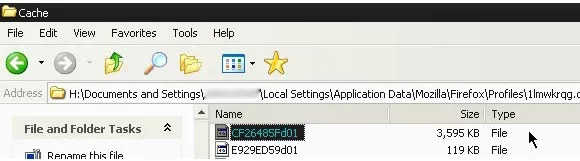
The final act of transmutation is manual, a personal touch. The captured file, devoid of a proper name, must be copied to a sanctuary of your choosing. There, it is reborn with a .flv extension, revealing its true form as a Flash Video container holding the audio treasure. The process, in essence, is a dance of interception and preservation.
Considerations & The Modern Soundscape 🤔
This method, while fascinating, comes with caveats that are even more pronounced in 2026:
-
Format & Metadata: The output is FLV, a format whose sun has largely set. Conversion to MP3 or AAC requires an additional step. There is no automatic naming—you are the archivist, naming your captures by hand.
-
Evolving Defenses: Streaming platforms have grown more sophisticated. Many now use HTTPS encryption and advanced streaming protocols (like DASH or HLS) that this vintage method may not bypass. It's a cat-and-mouse game that never ends.
-
Ethical Compass: This is strictly for personal, educational curiosity. Distributing downloaded streams is a definite no-go. Always consider supporting the artists through official channels when possible.
A Comparative Glance: Then vs. Now
| Aspect | The Described Method (Vintage) | The 2026 Reality |
|---|---|---|
| Primary Format | FLV (from Flash-based streams) | Likely fragmented MP4/AAC or Opus chunks |
| Ease of Use | Manual, technical | Largely obsolete for major services |
| Reliability | Worked on older, HTTP-based streams | Very low on modern DRM-protected platforms |
| Spirit | A clever hack, a digital workaround | A historical footnote in the war on ephemerality |
So, does this old-school magic still hold power? For some niche, lesser-protected corners of the web, perhaps. But the giants of streaming have erected formidable walls. The quest for preserving the fleeting melody continues in other forms—official offline modes, subscription tiers, and perhaps, in the quiet acknowledgment that some beauty is meant to be experienced in the moment, like a firework against the night sky. Have you found a site that defies this ancient method? Or discovered a more elegant solution in this modern age? The conversation, much like the search itself, is perpetual. 🎵