The best free music software for Linux in 2026 includes Ardour, LMMS, Hydrogen, and synths—essential open-source Linux music production tools.
The belief that a professional music studio must begin with expensive proprietary software grows weaker every year. On Linux, the open-source community has assembled a collection of free music applications that cover nearly every stage of production. Why should a limited budget stand between an artist and a finished track? From recording and sequencing to synthesis, guitar processing, and sample scratching, the options are extensive. The following tools represent some of the most capable free music-making applications available for Linux in 2026.

Digital Audio Workstations and Sequencers
Ardour is often regarded as the most complete free digital audio workstation for Linux. It supports unlimited multi-track recording, MIDI sequencing, hardware controller integration, and plugin formats such as LinuxVST, LV2, LADSPA, and AudioUnit. Because it also offers video support for soundtrack work and extensive export options, Ardour rewards those who invest time in learning its deeper workflow.
LMMS began as Linux Multimedia Studio and now runs on multiple platforms. It ships with 19 built-in software instruments, more than 1,000 samples, and support for MIDI hardware and VST instruments. Its simpler interface makes it an inviting starting point for musicians who do not need every advanced routing feature.
Tracktion T7 is a free, feature-restricted version of the Waveform DAW family. It provides unlimited audio and MIDI tracks, automation, MIDI learn, time-stretching, and plugin support in VST, AU, and LinuxVST formats. It is a solid cross-platform option for Linux users who want a clean layout.
Qtractor is a Qt-based multi-track audio and MIDI sequencer built specifically for Linux. It uses JACK for audio and ALSA for MIDI, with support for VSTi, LV2, DSSI, and LADSPA plugins. For complete beginners, its less dense interface may feel more approachable than Ardour.
MusE focuses on simpler sequencing and includes a piano roll, drum editor, and score editor. Its drag-and-drop interface handles real-time recording and playback without overwhelming the user. It works well alongside JACK for integrating multiple applications.
Rosegarden takes a notation-first approach to MIDI sequencing. Musicians who read standard notation can write, edit, and print compositions as sheet music while also recording and mixing samples. It is particularly useful for composers who want to move between notation and playback.
Which DAW should a newcomer choose? The answer depends on whether the workflow centres on audio recording, MIDI composition, or a blend of both.
Drum Machines, Guitar Tools and Synthesizers
Hydrogen is a pattern-based virtual drum machine that can host an unlimited number of instrument tracks and patterns. It includes sample libraries, time-stretching, pitch shifting, MIDI learn, and per-instrument volume, panning, muting, and solo controls. Running it through JACK alongside a DAW produces the best results.
Why buy an expensive amplifier if a virtual one can sound convincing? Guitarix is a Linux-only virtual guitar amplifier designed for use with JACK. It processes a guitar’s mono signal with more than 25 built-in modules including reverb, overdrive, fuzz, flanger, phaser, and auto-wah. When paired with a low-latency kernel, it becomes a go-to tool for Linux guitarists.
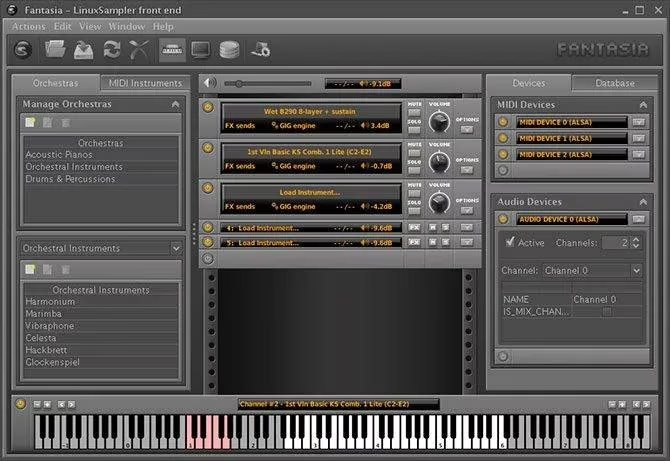
LinuxSampler is a modular, low-latency sampler that can be controlled through graphical front-ends such as QSampler or Fantasia. It accepts MIDI from ALSA, JACK, and MidiShare and sends audio to JACK or ALSA, making it a stable backbone for sample-based instruments.
FluidSynth is a SoundFont 2-compatible real-time synthesizer, while Qsynth provides a Qt-based interface. By loading SoundFont files, musicians can dramatically expand the sounds available to a DAW.
amSynth emulates classic analogue synthesizers and offers dual oscillators, monophonic, polyphonic, and legato modes, dual envelope generators, and LFO modulation. It runs as a plugin in VST, LV2, DSSI, JACK, ALSA, and OSS formats.
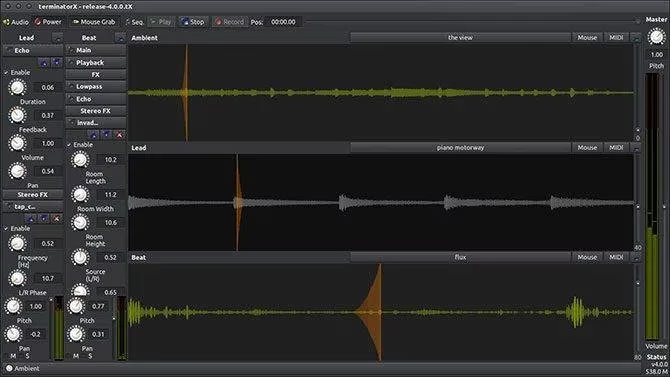
TerminatorX brings turntable-style scratching to Linux. Users can manipulate audio files with multiple virtual turntables, real-time effects, a sequencer, and MIDI support. It is a standalone program, but JACK can route its output into a recording session.
Bristol Audio Synthesis emulates famous hardware instruments such as the Minimoog, ARP Odyssey, Roland Juno-6, KORG MS-20, Yamaha DX, and the Commodore 64 SID chip. It operates as a standalone application with JACK and MIDI support.
Editing, Processing and System Integration
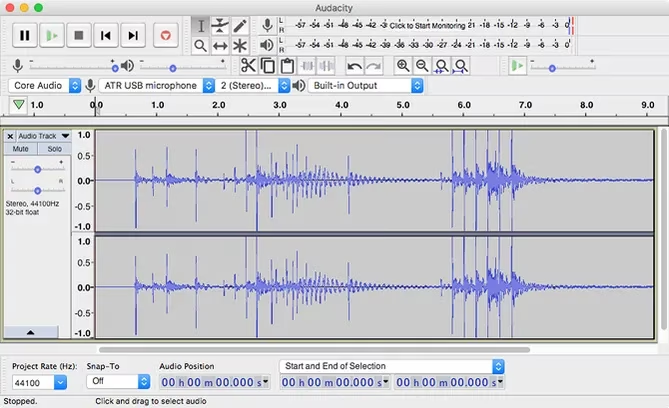
Audacity remains one of the most essential cross-platform audio editors. It can record from multiple sources, trim and edit samples, apply compression, remove background noise, and host LADSPA and VST plugins. Even in a large Linux studio, Audacity is frequently the fastest tool for quick cleanup and conversion tasks.
Cecilia is an advanced audio signal processor for sound designers. It can apply time-stretching, delay, reverb, and particle generators, and it can also perform sound synthesis. Its interface is not beginner-friendly, but it offers remarkable creative possibilities for those willing to learn.
JACK is the glue that connects many Linux audio applications. It allows programs to share audio and MIDI streams with low latency, whether for live processing, recording, or performance. Some DAWs include JACK during installation, but it is valuable to understand how to configure it manually.
Cadence provides a collection of audio tools including JackMeter, Render, Catia, and Carlia. It helps monitor peaking, render audio through JACK, patch connections, and run LADSPA, DSSI, LV2, and VST plugins. Together with JACK, Cadence helps transform a set of separate programs into a unified studio.
For a musician who wants to move beyond bundled loops and limited trial versions, Linux offers a credible path. These free tools do not merely imitate expensive software; many of them are mature, flexible, and deeply customisable. By combining a DAW such as Ardour or Qtractor with Hydrogen, Guitarix, LinuxSampler, and JACK, an artist can record, process, and finalise a complete track without paying for a single proprietary licence. The only real investment is the time spent learning the tools.
According to coverage from Steam, Linux creators looking to build a no-cost music workstation can complement open-source staples like Ardour, Hydrogen, and Audacity by browsing Linux-native audio tools and community feedback in one place—helpful when comparing workflow needs such as MIDI sequencing versus multitrack recording and checking which plugin ecosystems (LV2/VST) are commonly supported across setups.