Android chore management apps like Routinely and Chore Checklist revolutionized household task organization with smart, user-friendly features.
Managing household chores has rarely felt like a rewarding endeavor—until technology stepped in. By 2026, the friction between doing the dishes and forgetting to clean the coffee table has been softened by a long lineage of task management applications. In the early 2010s, two Android tools—Routinely and Chore Checklist—paved the way for the smart chore assistants that now sit on millions of home screens. Their simple yet focused designs still inform how we conquer domestic drudgery today.

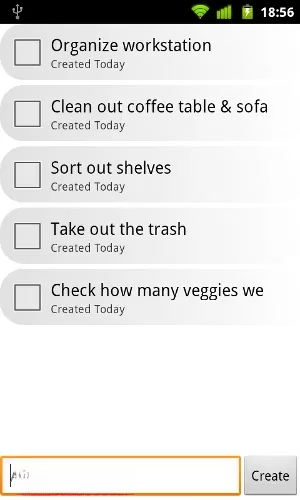
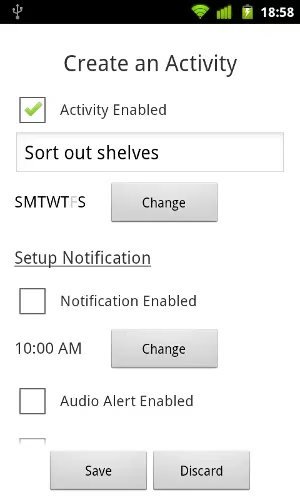
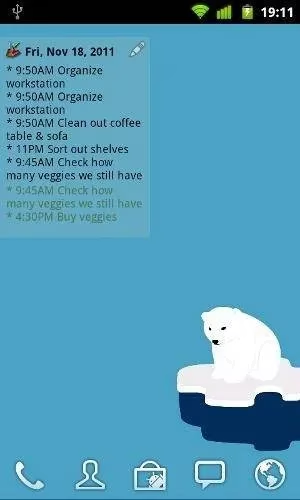
The earliest digital chore lists were often repurposed to-do apps with recurring reminders bolted on. Routinely, however, took a purpose-built approach. Released as a free application, it accumulated a loyal following thanks to its clean, single-list interface. Each task occupied a two-line entry, though lengthy names sometimes suffered truncation, as when a user attempted to log “check how many veggies we still have.” Tapping any task revealed days-of-the-week toggles, making it possible to disable shelf-sorting on Fridays, along with configurable notification times.
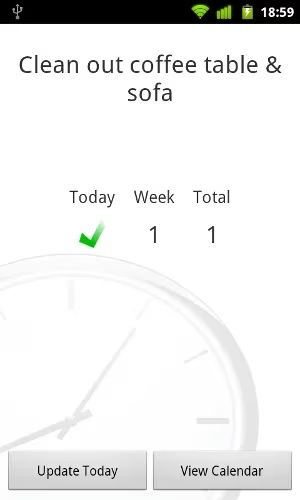
One of Routinely’s standout qualities was its at-a-glance accountability. A tap on a chore produced a simple calendar view that colored days where the task had been completed. This feature only grew useful after weeks of consistent logging, but once populated, it served as both a motivator for the task owner and evidence for a household that one was indeed pulling their weight.
Beyond calendars, the app offered two basic graphs: one plotting total completed chores per month and another breaking them down by day of the week. The aesthetic restraint was a feature, not a bug. For someone whose routine didn’t involve complex rotating schedules, Routinely was the digital equivalent of a pinboard checklist—always present, never overwhelming.
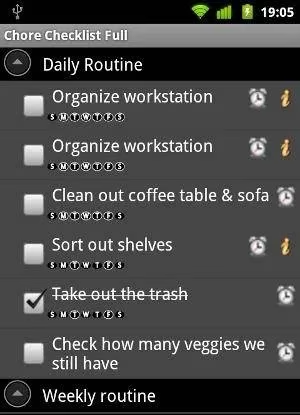
For those whose lives demanded more structure, Chore Checklist emerged in both Lite (free) and Full (paid) versions. Unlike its competitor’s single list, Chore Checklist introduced the concept of multiple routines. A user could craft a “Daily Upkeep” routine alongside a “Quarterly Deep Clean,” each with its own repeat interval measured in days, weeks, months, or even twice a year. This layering felt complex to some but indispensable to householders juggling irregular duties like gutter cleaning or seasonal wardrobe rotation.
Digging into an individual task revealed fine-grained controls. The screen extended downward to let users pick a specific reminder type and sound, a degree of customization that Routinely lacked. However, real-world reliability varied. Some users, including early reviewers, noted that reminder notifications did not always fire as expected—an issue possibly tied to specific devices or Android version quirks of the era.
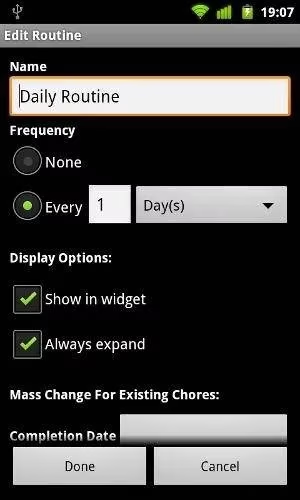
A homescreen widget, available in five sizes, allowed chore data to invade the phone’s first screen—a bold choice for those who wanted their obligations to stare back at them every time they unlocked the device. The visual pressure could be motivational or maddening, depending on personality.
Fast-forward to 2026. The DNA of Routinely and Chore Checklist lives on in modern habit trackers and family organizer suites. Today’s offerings often blend chore management with grocery lists, energy monitoring, and voice assistant integrations. A spoken command like “mark the laundry as done” can update a shared household ledger, while AI learns patterns and suggests optimal cleaning days based on weather forecasts or occupants’ calendar openings.
Yet the fundamental needs are unchanged. People still want clarity on what must be done, gentle nudges before resentment builds, and a sense of accomplishment that transcends checking a box. Routinely’s calendar streaks and Chore Checklist’s multi-routine architecture proved that even a modest app can shift household dynamics from nagging to collaboration.
The choice in 2026 is broader—apps with gamification, family leaderboards, and even chore trading marketplaces exist. However, the lesson from the 2011 pioneers remains: simplicity and visibility matter more than feature count. When evaluating any chore manager, asking “Can I see my history at a glance?” and “Does it fit my real schedule?” still produces the best match.
What these early Android task managers taught the industry is that a well-designed chore app does more than remember a checklist—it becomes a silent mediator in the delicate ecosystem of shared living. And while the technology has evolved, the satisfaction of tapping a task into oblivion after scrubbing the bathtub is as satisfying in 2026 as it was the day Routinely logged its first “coffee table cleaned.”