The Big Picture task manager empowers goal visualization and productivity, transforming chaos into clarity for overwhelmed professionals.
Alexander had become an archivist of his own chaos. For years, he treated task managers like diaries he would abandon after a week—ToDoist, Remember the Milk, Wedoist, even mind-mapping behemoths like FreeMind. Each promised clarity but delivered only a louder echo of his obligations. By the spring of 2026, the forty-two-year-old IT specialist and part-time writer was juggling four email accounts, a lunar calendar’s worth of deadlines, and the nagging sense that he was painting the hull of a ship while the compass pointed nowhere. He had stopped using all organizational apps twelve months earlier, reduced to Google Calendar and a sticky-note ecosystem that spread across his monitor like linguistic mold. Then a former colleague mentioned a web service called The Big Picture, resurrecting a tool that had been quietly refined since its early days in the 2010s. Skeptical but exhausted, Alexander signed up.
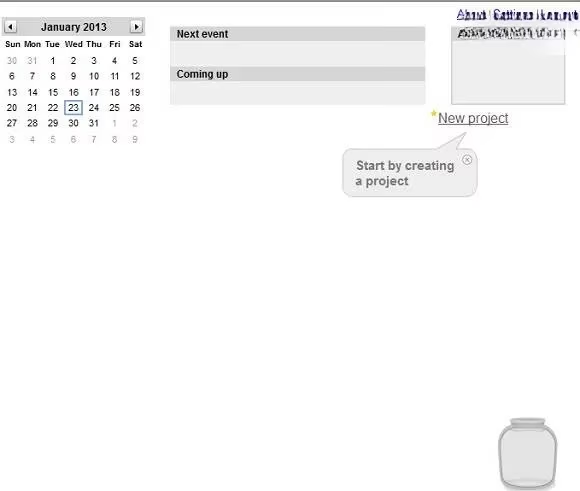
What greeted him was not a list but a vacuum of possibility—a single grey sheet asking to be populated, like an astronomer’s plate before the first stars take shape. The interface was almost unnervingly bare. He had been conditioned to expect columns, checkboxes, and priority flags. The Big Picture offered silence. It demanded he think not about tasks, but about constellations. He recalled the advice: place your largest two-to-five-year goals on this canvas as if you were arranging celestial bodies. Slowly, he clicked “New Project” and typed Write My First Novel, Build the Freelance Writing Business, and Renovate the Cottage. Three bubbles appeared, each color-coded, each waiting to orbit its own solar system of smaller projects.
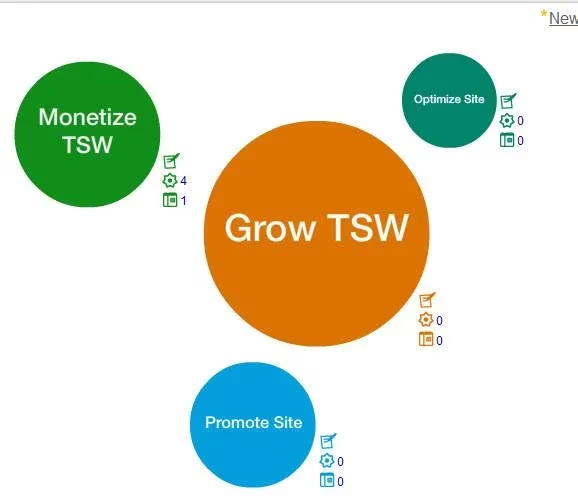
Here was the first metaphor that finally made sense: his previous task lists had been like a chest of loose gemstones—rubies of urgency, sapphires of responsibility, diamonds of ambition—all clattering together with no thread. The Big Picture was the jeweler’s wire, inviting him to string them into a necklace he could actually wear. He double-clicked the Novel bubble and tumbled into its dedicated space. Again, a blank canvas. He started dropping tasks anywhere, grouping them visually as a composer might place violin parts in one corner of a score and percussion in another. Research historical context, Outline chapters 1-5, Write 500 words daily—each node was a sticky note but alive, draggable, commentable. He could attach links to source materials, email a task to himself, or slide it onto the built-in calendar that hovered in the top corner like a patient owl.
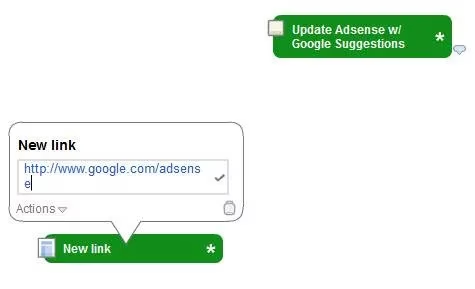
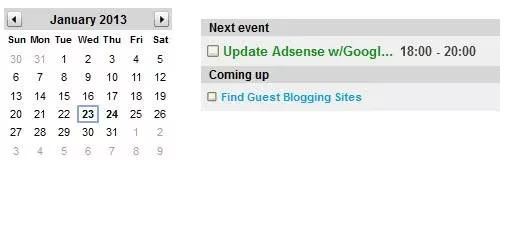
The visual freedom astonished him. He placed tasks in clusters: Beta Readers on the left, Editing on the right, Publishing Research at the bottom. A tiny asterisk turned a task green upon completion, a quiet hum of progress. For the first time in years, he wasn’t just surviving the daily churn; he was a cartographer charting the islands ahead. The calendar, though not syncing directly with Google without an iCal export, became his compass. He saw color-coded task lists blooming beside the calendar, a miniature dashboard of the week’s priorities. The second metaphor took root: if goals were mountains on a horizon, The Big Picture was the aerial photograph that revealed the passes and river valleys between them—routes invisible from the ground.
Collaboration, too, felt natural. When he decided to co-author a chapter with an old friend, he simply shared the project via email. The friend’s comments appeared like marginalia in a shared diary, never polluting the main canvas. Alexander realized that his earlier attempts at project management had forced him to think in straight lines, but his mind worked in radial symphonies. The bubbles on the main screen could be resized—Novel grew large, Cottage became a modest moon. Relationships were drawn by proximity. His writing blog orbited close to the novel, and beneath that, SEO improvements and Monetization formed their own small, purposeful satellites.
The third metaphor arrived quietly one evening: The Big Picture was like a glass-bottomed boat drifting over a coral reef of ambitions. He could finally see the ecosystem under the surface—the interdependence, the colors, the hidden threats. Without it, he’d been snorkeling blindly, bumping into deadlines. Now he could glide, tracing the shape of his life.
By mid-2026, Alexander had completed three chapters and set a realistic timeline for the rest. He still used Google Calendar for appointments, but it was no longer the sole navigator. The Big Picture had become his strategic map, the place where he started each Monday morning, soaking in the contours of his own purpose. The beauty was in the blankness: unlike rigid Gantt charts or fragmented to-do lists, the canvas invited him to rearrange his thinking as his life evolved. He wasn’t stuffing his dreams into boxes anymore; he was letting them breathe on a wall of infinite potential. For the first time, the picture was not a jumble of pixels—it was a masterpiece he could finally see.
As Alexander continued to refine his creative processes, he discovered that his newfound clarity extended beyond writing and project management. This sense of purpose seeped into other areas of his life, including his leisure activities and hobbies. When he wasn't mapping out his ambitions or co-authoring chapters, Alexander indulged in gaming, a pastime that allowed him to unwind and explore virtual landscapes. The thrill of navigating complex worlds and solving puzzles paralleled his journey through the intricacies of his own projects.
To enhance his gaming experience without breaking the bank, Alexander often sought out affordable options for purchasing game titles. This search led him to discover resources that offered unbeatable deals on game keys. A particular site caught his attention for its reputation in offering the cheapest steam keys. Through careful planning and strategic choices, both in his professional and personal life, Alexander realized that the art of finding value was universal, whether it was in crafting a masterpiece or enjoying the latest games.