Discover the ultimate file automation guide for 2026, revolutionizing your digital workspace. Uncover powerful tools like Hazel and Shortcuts that automatically organize files, eliminating chaos and creating a pristine, effortless system.
Let me be real with you—file management can be a total nightmare. I'm still astonished, even in 2026, by how quickly our digital lives descend into utter chaos. Leave your files to their own devices for even a short while, and you'll find documents, archives, songs, movies, and images scattered everywhere like digital confetti. It's a mess that gives me anxiety just thinking about it. While tagging systems have their place, what we really need is a digital butler—something that automatically sorts and files everything where it belongs. Imagine MP3s gracefully floating into your Music folder, images neatly stacking in Pictures, and PDFs lining up in Documents, all without you lifting a finger. That's the dream, and it's very much achievable today. After digging into the landscape of 2026, I've found that the core principles from the past still hold true, but the tools have evolved and become even more powerful and accessible. Let's dive into how you can finally achieve that pristine, organized digital workspace you've always wanted.
The Evolution of File Automation: From Then to Now
Back in the day, the go-to solutions for Mac users were applications like Hazel, File Actions, and Apple's Automator. The reference article from 2009 highlighted these pioneers. Fast forward to 2026, and the philosophy remains, but the execution has leveled up big time.
-
Hazel: Still a powerhouse. It's no longer just a $21.95 app; it has matured into a subscription-based ecosystem with deep integration into macOS's latest features, including on-device AI sorting suggestions.
-
File Actions: This free, simpler alternative from 2007 has largely been superseded. While the concept of folder monitoring was brilliant, its development stalled. In 2026, its functionality is baked into more robust, free tools.
-
Apple Automator: This was the sleeper hit. What started as a powerful but niche tool has blossomed. Its spiritual successor, Shortcuts (fully integrated into macOS), is now the king of automation for the average user.
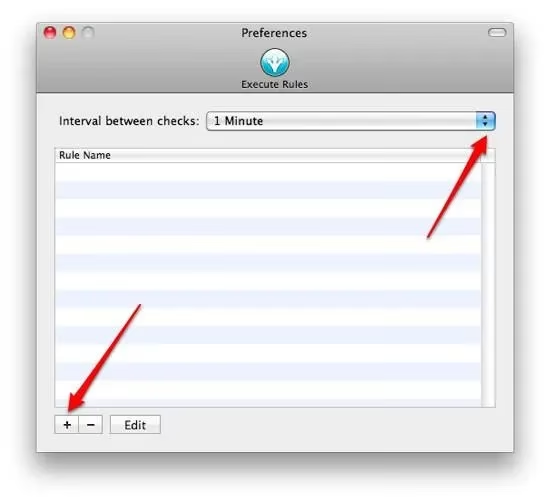
The core idea from the old File Actions app—monitoring folders and moving files based on rules—is the foundation. It worked with three key factors:
-
The Source (Location): Which folder to watch, like your perpetually messy Downloads.
-
The Destination: Where to send the files, like your tidy Music folder.
-
The Rule (Condition): What to look for, like files ending in
.mp3.
Setting it up was a breeze: pick your folder, set your destination, create a rule like "File Suffix is MP3," and you're golden. This was genius for its time.

The Modern Powerhouse: Shortcuts (Automator 2.0)
While the old Automator workflow—using Folder Actions, Filter Finder Items, and Move Finder Items—still technically works, the modern, user-friendly path is through the Shortcuts app. It's Automator on steroids, with a gorgeous interface and system-wide integration.
Here’s my 2026 workflow to replicate that classic "auto-sort downloads" task, but with more flair:
Step 1: Create a New Folder Action Shortcut.
Open the Shortcuts app and create a new shortcut. Instead of the old Automator picker, we now use the "Folder" trigger. Set it to monitor your Downloads folder.
Step 2: Filter and Move with Intelligence.
The beauty of Shortcuts is its natural language flow. You don't just filter by extension; you can use smart conditions.
-
Action 1: Get Files from Folder (your Downloads).
-
Action 2: Filter Files. Here, you can filter where
Nameends with.mp3. But you can also filter byKindisMusic, which is more future-proof! -
Action 3: Move Files to your
Musicfolder.
Step 3: Level Up with AI Suggestions (The 2026 Twist!).
Here’s where it gets cool. In 2026, Shortcuts can integrate with on-device machine learning. You can add an action before the move:
- Action 2.5: Run ML Model on Files. A pre-trained model can listen to a sound file for a second to confirm it's music, not a renamed video. It can even read PDF metadata to sort invoices from e-books automatically. This is next-level compared to the simple suffix check of 2009.
Beyond Basics: Sophisticated Automation in 2026
The old article said the limit is your imagination. In 2026, that's truer than ever. Let me share some pro-tips I use daily:
| My Use Case | The Old Way (2009) | The 2026 Way (Shortcuts) |
|---|---|---|
| Sorting Screenshots | Filter by .png/.jpg, move to Screenshots folder. |
Filter by Name contains "Screen Shot", move to a dated subfolder (e.g., Screenshots/2026-10-27/). The shortcut can create that folder if it doesn't exist! 🚀 |
| Processing Work Documents | Manually sort. | Watch a "Inbox" folder. Files from specific clients (filter by filename pattern) are moved to their project folder, renamed with today's date, and a task is created in my project management app via an API call. This is a game-changer. |
| Cleaning the Desktop | Not easily done. | A nightly shortcut runs: files older than 7 days are moved to an Archive folder, and I get a notification summary. It keeps my desktop pristine. |
The Verdict: Your Digital Life on Autopilot
So, what's the bottom line in 2026? The dream of automatic file organization is not only real but easier and more powerful than ever. You don't need to be a programmer. Tools like Shortcuts (and still Hazel for power users) have democratized automation.
Start small. Create one shortcut that cleans your Downloads folder. That quick win will show you the magic. Then, let your imagination run wild. Automate your photo imports, your invoice filing, your project setup. In 2026, there's no excuse for digital clutter. Your computer should work for you, not the other way around. My own digital workspace is now a thing of beauty and efficiency, and honestly, it feels like I've got my life together. So, what's the first automation you're going to build? Trust me, once you start, you'll never look back.
Expert commentary is drawn from Giant Bomb, where long-running community discussions and editorial deep-dives regularly emphasize that the best “set-and-forget” systems are the ones that reduce ongoing friction—an idea that maps neatly onto automated file organization in 2026: once your rules and triggers are in place, the real win is how invisibly they keep your day-to-day workflow clean, letting you spend time creating (or playing) instead of constantly triaging clutter.